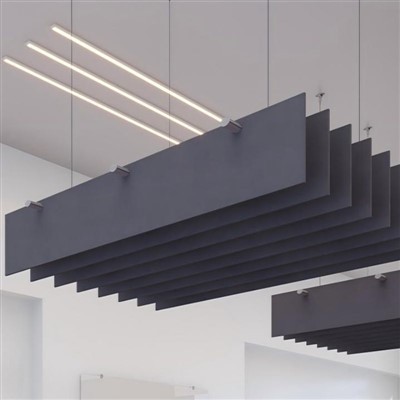


Glass fiber spatial sound absorbers are acoustic components made with glass fiber (GF) as the core material and installed using a suspended method. They are mainly used to absorb indoor sound energy and reduce reverberation time. Their working principle combines the physical properties of porous sound-absorbing materials with the acoustic advantages of spatial suspension.
Core Working Principles
Porous Fiber Structure Sound Absorption: Glass fiber material consists of numerous long, intertwined glass fibers, forming abundant micropores and interconnected voids. When sound waves strike, they cause air vibrations between the fibers, and under the effects of friction and viscous resistance, sound energy is converted into heat and dissipated.
Suspended Installation Enhances Absorption Efficiency: Unlike wall-mounted or ceiling-mounted installation, spatial sound absorbers are suspended in the air, allowing sound waves to strike from multiple angles. At the same time, sound waves reflect multiple times between the absorber surface and the building ceiling, being repeatedly absorbed, which significantly enhances sound absorption.
Multi-Surface and Edge Effects: The suspended structure allows all surfaces of the absorber to participate in sound absorption. For the same projected area, it is equivalent to increasing the effective sound-absorbing area. Diffraction of sound waves at the edges further enhances absorption of mid- to high-frequency noise.
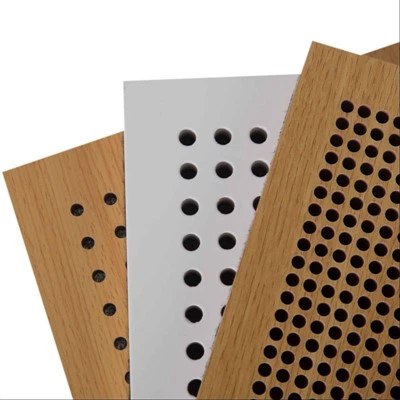
Low-Frequency Absorption Optimization (Special Shapes): Some specially shaped glass fiber spatial sound absorbers are designed with perforations or specific geometries to effectively improve low-frequency noise absorption, compensating for the weaker low-frequency performance of conventional porous materials.
Summary of Performance Characteristics
High-Efficiency Absorption Frequency Range: Significant absorption effect for mid- to high-frequency noise (such as human voice and equipment noise); low frequencies require structural design assistance.
Flexible Installation: Does not occupy floor or wall space, suitable for large-span or high-clearance locations such as gymnasiums, conference rooms, and recording studios.
Dual-Effect Potential: Some glass fiber materials (e.g., Yutson products) combine sound absorption and sound insulation functions, as the porous structure simultaneously provides energy dissipation and damping attenuation.