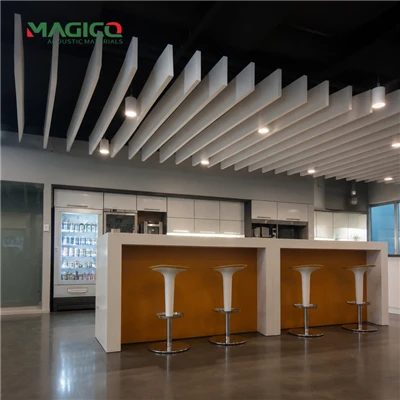


Basic Characteristics of Fiberglass Ceilings
Fiberglass is a composite material made by drawing molten glass into fibers and is commonly used in soundproofing, thermal insulation, or decorative ceilings. Its typical characteristics include:
Appearance: The surface usually has a uniform granular or fibrous texture, with colors mainly in white or light gray, and some products may have a matte coating.
Touch: When lightly touched, it feels slightly rough but not sharp to the hand (direct contact with untreated fiberglass may cause skin itching).
Flexibility: The material is lightweight and somewhat elastic. When tapped, it produces a dull sound, unlike the crisp sound of gypsum board.
Specific Methods for Judgment
Visual Inspection
Shine a strong flashlight on the ceiling; fiberglass will reflect a fine fibrous halo, whereas gypsum board or PVC panels will not.
Observe the seams: The edges of fiberglass panels often have mesh or frayed marks, as they need to be fixed with adhesive.
Physical Tests
Gloved touch method: Wear protective gloves and lightly scrape the surface. If fine fibers fall off and the material is soft, it may be fiberglass (note: avoid direct skin contact).
Burning test (operate with caution): Cut a very small sample and ignite it with a lighter. Fiberglass is not easily flammable and will curl, but this method must be carried out safely.
Professional Tool Assistance
Infrared Thermography: Fiberglass has excellent thermal insulation properties, showing more pronounced temperature differences than ordinary materials (reference value: thermal conductivity about 0.04–0.05 W/(m·K)).
Laboratory Composition Analysis: Samples can be sent for inspection, observing fiber diameter under a microscope (usually 3–20 micrometers, source: "Code for Fiberglass Products for Construction" GB/T 18370).